Aksaray Province, Cappadocia Turkey


Ihlara valley


Aksaray offers the traveller unique journeys into one of nature's showcases. It boasts beautiful geological formations and a rich history. It is a charming town at the heart of the Cappadocia region.


The Ihlara Valley is a wonderful example of nature, people, history and art being bound togother in one place. The innermost secrets of it come slowly to light when you begin to explore.


The first civilisation at Aksaray on the volcanic tufa-rock lands of Cappadocia was at Asikli and dates from 8.000 years B.C. At Asiklihoyuk (mound) is the oldest village belonging to the Neolithic Period in Anatolia and the Near East.


In its long history Aksaray has been the cradle to various civilisations. From 3000 B:C. to 2000 B.C. the Hatti tribes lived in Anatolia. During this period Assyrian merchants traded in this area.


Towards the end of the period of colonisation, the Hittites coming from the Caucasus around 1700 B.C. founded small city-states and made Anatolia into a military state.


In the 1st C. A.D. St Paul and the disciples began to spread Christianity provoking the polyheistic Romans. For the sake of safety the early Christians started to seek out less confrontational places to settle. Also many religious men seeking solitude came to this region.


Aksaray came under Seljuk sovereignity in 1142 during the reign of Kilicaslan II. At this time palaces, madrasas, lodged and caravanserais were built. Kilicaslan II. built a palace and changed the name from Arkhelais to Aksaray (lit. pure palace) and it became a virtual second capital city. The city did not allow bad people to enter. And because of this it was known as "Sehr-i Suhela" meaning the place where goog people live. Aksaray became part of the Ottoman Empire in 1470 when it passed to Ishak Pasha. After the conquest of Istanbul the city was under populated and many Aksaray people were resettled in Istanbul, which is the reason that there a district of Istanbul named Aksaray.


In 1920 Aksaray became a province. In 1933 that status was annulled and it became of the province of Nigde. On June 15th, 1989 it became a province once more. The region has been home to different religious artefacts found here belonging especially to the Islamic and Christian periods. Of hundreds of examples 29 have been chosen as being especially valuable from the point of view of religious tourism. Of these eight are Islamic, each a masterpiece in its own right that attract hundreds of thuosands of visitors. The examples are:
Ulu Mosque, Egri Minaret, Tapduk Emre Turbe, Seyh Hamid-i Veli Turbe, Kilicaslan Turbe, Yunus Emre Turbe, Selime Sultan Turbe and Kaya Mosque.

Read more »

Konya Province, Cappadocia Turkey


Ivriz Rock relief - Konya


The early permanent settlements in and around Konya go back to prehistoric times. The cultures of the Neolithic, Paleolithic and Early Bronze Age can be found within this period of time.


The mounds within which the early settlements are burled are within the borders of Konya. The findings of the Neolithic period have been dug-out during Catalhoyuk excavations. The diggings made in Catalhoyuk revealed that Konya has been an old city of civilization since people started to run a settled life in 7000 B.C. The existence of Ivriz Rock relief, Eflatunpinar, Glistra, Sille St. Elena church is another point which shows that Konya is a centre of hitory and culture.


The Hittite settlements were at Karahoyuk, which lies on the outskirts of Konya today. The archeological excavations have given light to the way of living of those people who lived on this land in those days. The Phrygians, who ended the Hittite domination on Asia Minor, were the migrating tribes form the Thrace. The findings from Aleaddin mound, Karapinar, Gicikisla and Sizma belong to the seventh millennium B.C.. Konya (Cavania) was invaded by the Lycian, Alexander the Great and the Romans. The Roman domination all over Asia Minor was long-lasting and Konya was Iconium then (25 A.D.)

Saint Paul, who landed at Antalya and made his way to the inner parts of Central Anatolia, made her a land of the Ottoman Empire. From there, passed through Antiochia (Yalvac) and came to Iconium. In those days Lystra, Laodica and Sille were the predominant Byzantine settlements. The penetration of Islam into Asia Minor brought the Arabian raids, which were made through Konya. After the Battle of Malazgirt in 1071 a large part of Anatolia including Konya was captured by Seljuk Turks and the dominance of the Eastern Roman Empire began to disappear. Suleyman Shah, the Anatolian Seljuk Sultan, declared Konya the seat of his crown in 1076. In 1080 Iznik was made the capital and in 1097, once more Konya was declared the capital of Anatolian Seljuk Empire staying that way until 1277. Karamanoglu Mehmet Bey took the rule of the Karamanogullari State. The Ottoman Sultan Murad II. captured Konya in 1442 and ended the Karamanogullari rule. Konya enjoyed many estimable years and made herself a notable reputation during the Ottoman reign. Konya was the halting place of Yavuz Sultan Selim during his campaigns to Egypt a Persia. Suleyman the Magnificent and Murad IV. halted in Konya on their way to Baghdad.

The city grew larger a developed rapidly after 1923. The considerably rich background of Konya has been enough to make her to be considered as an open air museum with numerous historical sites and a large number of works of art. Karatay, Meram and Selcuklu districts are up the Konya Metropol.

Read more »

Central Anatolia

The central Anatolia plateau forms the heartland of Turkey: ochre-hued, cleft by ravines and dominated by volcanic peaks. The boldly contoured steppe has a solitary majesty covered with wheat fields framed by ranks of poplars.

Cappadocia, Central Anatolia

The central Anatolia plateau was also cradle of human civilization. At Catalhoyuk, remains of settlements as old as the eight millenium BC have been unearthed. Here in the homeland of many civilizations and the historic battleground between East and West, the Hattis, Hittites, Phrygians, Galatians, Romans, Byzantines, Seljuks and Ottoman all fought for their sovereignty and established their rule. In the 11th century, migrating Turks from the east made the plateau their own. During its turbulent history, Central Anatolia has endured invasion by great conquerors, such as Alexander the great and Tamerlane. In the course of ten millennia of habitation, the denizens of the area have reflected in their art the dramatic contours of the surrounding landscape, from the vigorous paintings of Catalhoyuk and the confident lines of Seljuks architecture, to more recently, the impressive modern from of Ataturk's mausoleum.


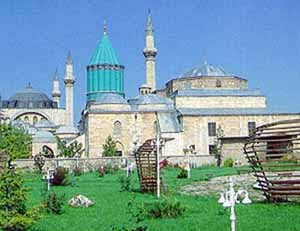
The most important city of central Anatolia is Ankara. Ankara is capital of Turkey. The city of Ankara lies in the center of Anatolia on the eastern edge of the great, high Anatolian Plateau, at an altitude of 850 meters. The province is a predominantly fertile wheat steppeland, with forested areas in the northeast. It is bordered by the provinces of Cankiri and Bolu to the north, Eskisehir to the west, Konya and Aksaray to the south, and Kirikkale nar Kirsehir to the east.Mevlana Museum, Konya

The region's history goes back to the Bronze Age Hatti Civilizaion, which was succeeded in the 2nd milliennium BC by the Hittites, in the 10th century BC by the Phrygians, then by the Lydians and Persians. After these came the Galatians, a Celtic race who were the first to make Ankara their capital in the 3rd century BC. It was then known as Ancyra, meaning "anchor" one of the oldest words in the language of the sea-loving Celts. The city subsequently fell to the Romans, and to the Byzantines. Seljuks Sultan Alparslan opened the door into Anatolia for Turks at the victory of Malazgirt in 1071. Then in 1073, he annexed Ankara, an important location for military transportation and natural resources, to Turkish territory.

Read more »

Kayan Tadian, Saggas Rescue

The Saggas Team in Action


Read more »

Goreme open air museum


First structure is monastery of nuns at the Goreme open air museum. In fact, the monastery of nuns known as six or seven floors but can be visited only three floors yet. The connection between the floors of the monastery is provided with tunnel and tunnel entrance are closed with sliding stones like underground cities of Cappadocia. There is a dining hall in the first floor, second floor has a chapel which decorated with frescoes and third floor also has a church with geometric decoration. There is Monastery of Priests near the Monastery of the nuns. Only a few rooms on the ground floor can be visited for into the rock layers are destroyed. A little later there is Hagios Basileos church which is known a tomb chapel walls decorated with frescoes. Near this church there is Aynali monastery with places around a courtyard. Aynali monastery has a big room which suppositional meeting room, a church and tomb rooms. Elmali monastery, for many years been used as a loft, all entries have been closed and thus without destroying frescoes hardly reached today. Understanding that the church is decorated in two differnet periods by means of red paint figurative decorations bottom of the poured frescoes. There is Barbara Church behind the Elmali monastery, Barbara Church walls are decorated with geometric figures and animal pictures. Just ahead Church of Hagia Katherina' frescoes largely damaged. Yilanli church has a church, refectory, and other places. It has been named as Yilanli Church (Church with snake) for on one of the frescoes St. Georgios fight with a dragon on a horse.


Goreme Open Air Museum is a member of Unesco World Heritage List since 1984. Open everyday between 8.00 a.m and 5.00 p.m. in winter months close earlier. Tel: 00 90 384 271 21 67 (From out of Turkey)


How can you go: Goreme open air museum is near the Goreme town of Nevsehir province. Nevsehir is 670 km. far from Istanbul, 280 km. from Ankara, 750 km. from Izmir. Goreme is 15 km. from Nevsehir center, you can go by bus, minibus or taxi to Goreme from Nevsehir. You can go by walking to museum from Goreme in 20 minutes.

Read more »

Turbel Hotel

Turbel Motel, located in Cavusin village enjoying aprime position with great views of the surrounding area and the old cavusin village, has been converted from a local farm house into a nice hotel.
The panoramic view of its restaurant extends on theancient village troglodyte and towards the other villages of Cappadoce (Avanos, Göreme, Uchisar).
The Turbel motel is a good base for many excursions to following sites; Pasabagi, Zelve, the pink valley, thered valley, the rose valley. Often public transportation services (dolmus) makes it possible toreach all the other sites of Cappadocia.


How to Come The very calm hotel is located at CAVUSIN, typical village in full heart of Cappadoce.
Road accesses eases. To 3 kms of GÖREME. Airport of KAYSERI Parks railway KAYSERI A 60 kms
Rooms: - All with hot water, Concues in the local tradition, Ceilings drink some for a betterventilation, 5 rooms with bath-tub - WC, 9 rooms with shower - WC, 4 rooms troglodytes in thecourse of installation, 5 rooms voutees.


www.turbelhotel.com

Read more »

Assiana Cave Hotel

Assiana House is a cave hotel located in the old part of Urgup (Esbelli area), and has 5 rooms with bathrooms and beautiful authentic decoration.

This family run small hotel of Cappadocia makes your stay a memorable and unforgettable one.


All our guests can use the swimming pool of the next door 4 star hotel at a price of EURO 8 per person for the whole day.

http://www.assianahouse.com/

Read more »

YILDIZ Hotel

Since 1989 Yildiz Hotel receved is guests without any pretention in a typical Turkish house surrounding by a lovely garden ( 2000 m2 )where the breakfast is provided. There is 19 strandart rooms, 3 suit rooms ( all with private bath room) 1 indoor restourant with a fire place. You will always be wellcomed in this small family hotel.

In Anatolian House, For Turkish hospitable.. Yildiz Cave Hotel


http://www.yildizhotel.com

Read more »

Hotel Karlikevi

KarlikEvi is a boutique hotel, situated in a place with the most beautiful panoramic view of Cappadocia, it has Yoga and Meditation Salon , Art and Craft Centre, a small farm and a wide field where Ecological agriculture takes place. It has also an 80-person Meeting Hall, 20 seperate rooms which change from 45 to 110 m² and Honeymoon suites uniquely decorated. Constructed with lava stones , our rooms are perfect for listening to the silence , sitting in the jakuzi sipping your wine to throw off the weariness of the day while watching the Uchisar Castle and Kizilcukur Valley. If you want to experience the Anatolian Culture and be accommodated with the Uchisar hospitality , KarlikEvi is waiting for you and your guests.


http://www.karlikevi.com/

Read more »

Hotel Melis

Melis Hotel is 300 years old Greek House which welcomes you with its charming atmosphere. Located in the town Urgup, which is the heart of Cappadocia that can offer. The popular spots in Cappadocia, shopping centers, restaurants, cave bars are all in within walking distance. Travel Agents, bus and taxi stations In the restful village morning, you can have your breakfast in Melis' verdured garden. At night, the darkness and the tranquility of the garden is broken by the fire of introducing barbecueare also within easy reach. Each of our rooms come equipped with direct dial telephone, satelitte TV and central heating which is great for Cappadocia winters! Our cool and cozy courtyard offers our guests a quiet and comfortable place to relax during their stay. We offer an excellent blend of Turkish warmth and hospitality with modern, clean facilities.


Read more »

 
Great HTML Templates from easytemplates.com.